
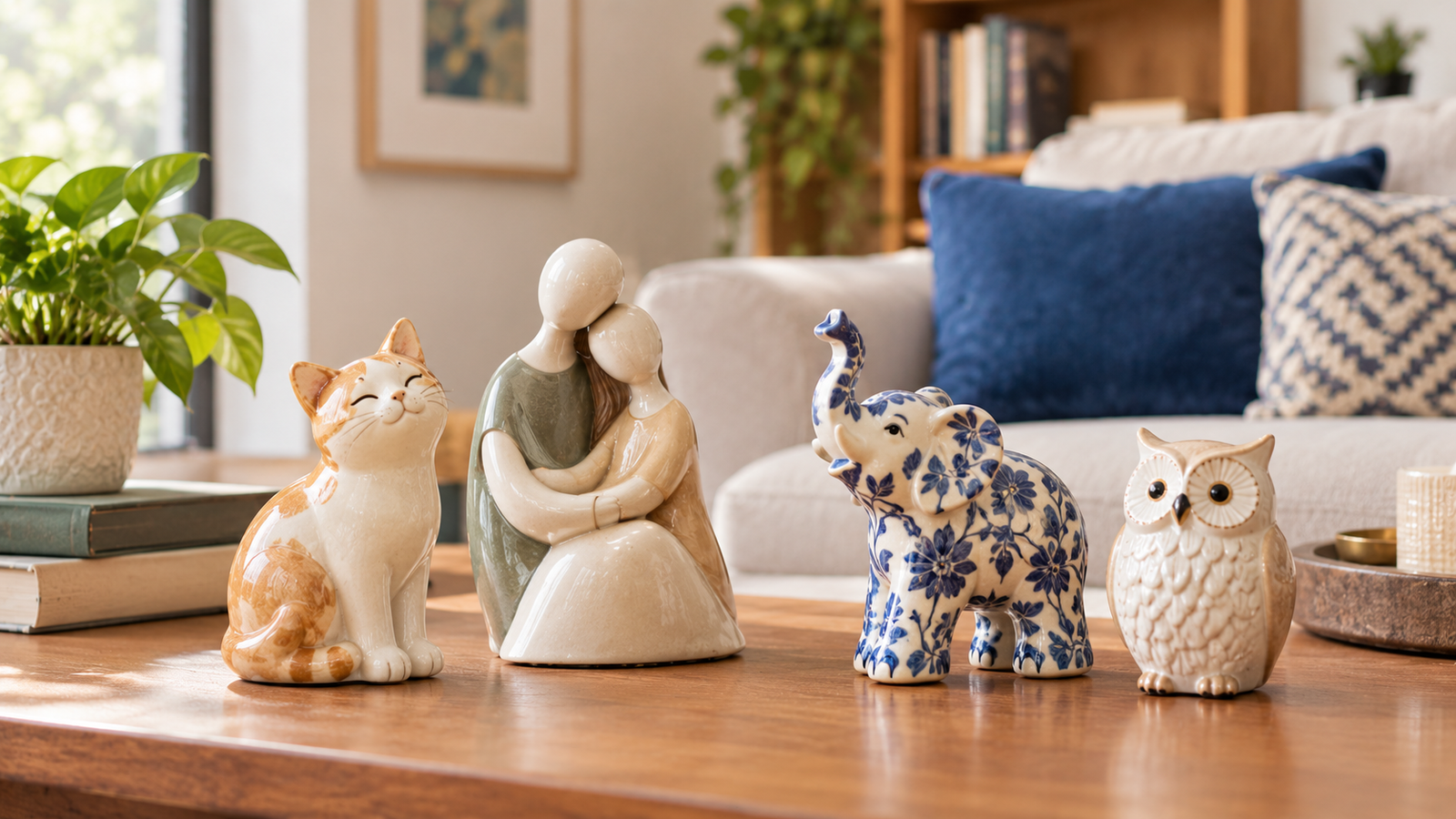
Most decorative objects have a season. They come out in December, or they suit one room and look out of place in every other, and the rest of the year they sit in a box. Hand-painted ceramic figurines are one of the few exceptions, because a well-made animal or angel reads as craft rather than as decoration tied to an occasion, and craft does not expire in January.
That is also what separates a collection from a shelf of ornaments. Pieces bought one at a time, in the same material and the same register, accumulate into something coherent. Pieces bought at random never do, however nice each one looked on its own.
What makes a figurine worth the shelf space
Three things decide it, and none of them is the subject. The first is the finish: hand-painted ceramic holds its colour and picks up light in a way that moulded resin does not, and the difference becomes obvious once two pieces sit side by side. The second is scale. A collection built from wildly different sizes never settles visually, so it pays to decide early whether you are collecting small pieces that group together or larger ones that stand alone. The third is edition. Special and limited editions carry a year and a story, which is what turns an object into something worth passing on rather than replacing. Keeping those three in mind makes the choice between collectible figurines far less arbitrary.
Five pieces and what each one is for
This selection of porcelain figures spans editions, sizes and subjects.
Teddy in ceramica Aurea Special Edition 2026
Best for starting a dated collection. The teddy is the most recognisable character in the range, and the Aurea special edition places it in a specific year rather than leaving it undated. That matters more than it sounds: a dated piece anchors everything bought afterwards and gives the collection a starting point. The finish is the draw here, with the Aurea treatment lifting a familiar shape into something that holds attention on an open shelf.
Angelo dei nonni Limited Edition 2026
Best as a gift with meaning attached. The grandparents’ angel is built around a relationship rather than a season, which is why it sits comfortably in a home all twelve months. Limited edition status makes it a considered gift rather than a default one, and the subject gives the recipient an obvious reason to keep it visible. For a milestone birthday or an anniversary, it is the piece in this list that carries the most weight.
Anatra mandarina in ceramica, grande
Best as a standalone statement piece. The mandarin duck is the most colourful subject here, and at the larger size it does not need company to hold a surface. Place it alone on a console or a wide windowsill and it functions as the single decorative object in that spot. The plumage is where the hand-painting shows most clearly, and it is the piece to choose when the goal is a focal point rather than a group.
Coppia di germani in ceramica, grande
Best for filling a wider surface. A pair reads differently from a single figure: it suggests relationship and movement, and it fills a shelf or a mantelpiece far more naturally than one object placed centrally. The larger format keeps the pair visible from across a room. This is the piece to choose when the surface is too wide for a single figurine but too shallow for a full group.
Anatroccolo germano in ceramica, piccolo
Best for building a group over time. The small duckling is the entry point, and the piece most likely to be bought repeatedly. Small figures group well, tuck into gaps between books and travel easily between rooms as the arrangement changes. It also works alongside the larger ducks in the same range, so a collection can grow in scale rather than only in number.
Keeping them looking new
- Dust with a dry soft brush rather than a cloth, which catches on painted detail.
- Keep pieces out of direct sunlight, which dulls colour slowly and unevenly.
- Leave a finger’s width between figures so none is knocked while another is moved.
- Store seasonal pieces wrapped individually, in their original boxes where possible.
The Takeaway
A collection worth having is built slowly, in one material, with a clear sense of scale. Start with a dated edition, add a standalone piece for a surface that needs one, and let the smaller figures accumulate around them. Done that way, the shelf keeps working through every season instead of being packed away with the decorations. Anyone starting out will find the figurine collection in ceramic a straightforward place to begin. More on living with things that last appears regularly on 2minuteread.com.