
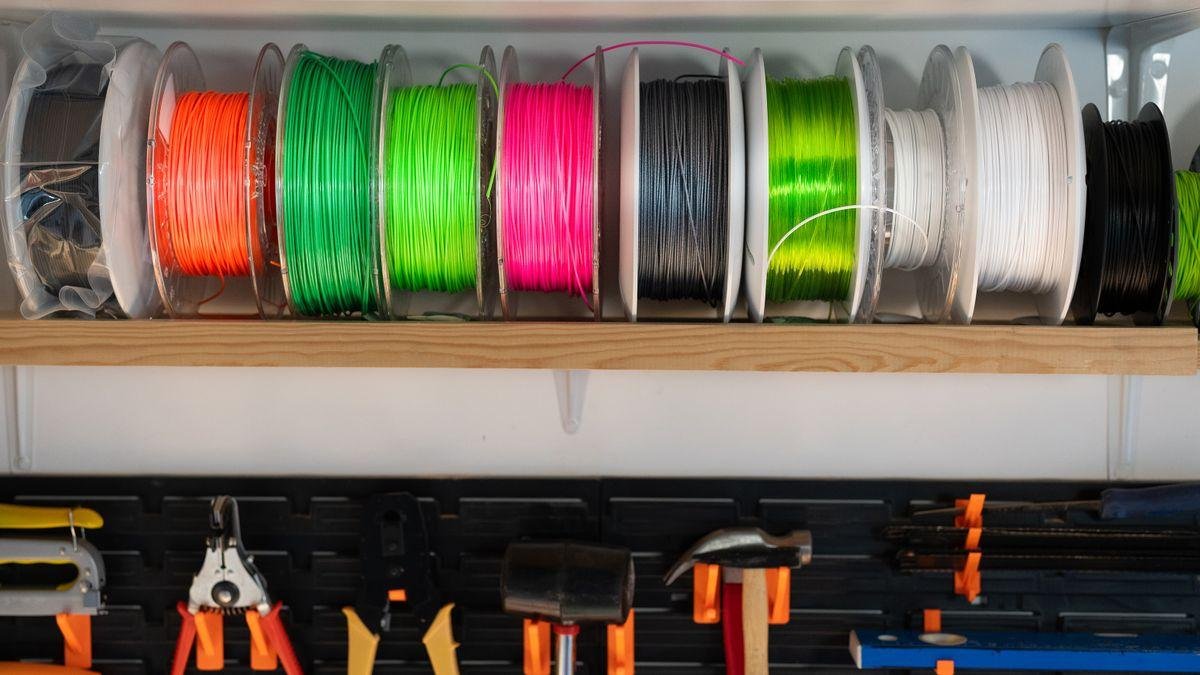
Once you start printing parts that actually do a job, such as brackets, mounts, jigs and replacement pieces around the house or workshop, standard PLA starts to show its limits. It can bend under load, creep over time and soften with heat. Carbon fiber filament and other engineering materials add stiffness, strength and temperature resistance, and they are among the most worthwhile spools to pick up while Black Friday prices are on.
What Fiber Reinforcement Changes
Reinforced filaments mix short strands of carbon or glass fiber into a base plastic. The fibers act like a skeleton inside every layer, making parts noticeably more rigid and reducing shrinkage as they cool, which helps larger prints stay accurate. Carbon fiber also gives a matte surface that hides layer lines well. Glass fiber tends to add strength and heat resistance in a slightly different balance. The trade-off is that fibers are abrasive, so a hardened or wear-resistant nozzle is a sensible companion for heavy use.
Choosing between these materials comes down to three questions. How stiff does the part need to be? Will it see heat, such as in a car or near a motor? And will it live outdoors in the sun? Carbon-filled PLA answers the first for indoor parts, PET-based blends cover heat and load, and ASA-based blends handle weather. Matching the PET-CF filament or other blend to the job means fewer reprints and parts that hold up from the first try.
The Materials, Ranked by Job
PLA-CF
Best for: stiff, good-looking parts on any printer.
With 10% carbon fiber in a PLA base, this is the easiest reinforced material to start with. It prints at 200 to 230°C, does not need a heated bed and delivers 1.3 to 1.5 times the strength of ordinary PLA with a smooth matte finish. It comes in eight colors and suits camera mounts, drone parts and desk accessories.
HS PETG
Best for: tough everyday functional parts.
Not fiber-filled, but a step up from PLA in toughness and impact resistance. It is described as tougher than PLA and more rigid than TPU, with good layer adhesion and print speeds from 100 to 350 mm/s. A wide palette of basic, metallic and transparent colors makes it a versatile workhorse.
PET-CF
Best for: heat-resistant, dimensionally stable parts.
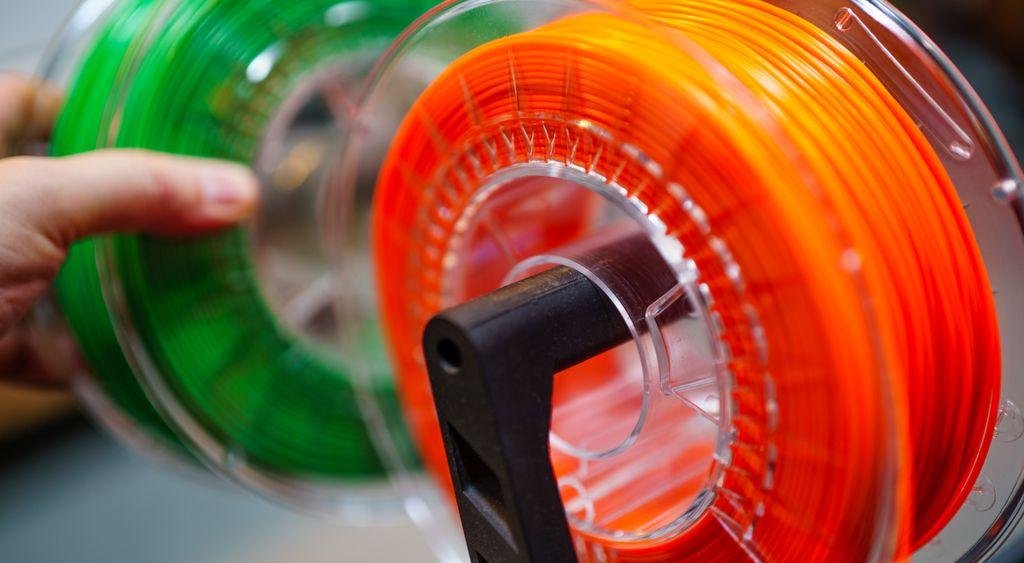
With 15% carbon fiber and a heat deflection temperature of 205°C, this industrial-grade material offers excellent rigidity and tensile strength with low shrinkage. It prints at 260 to 290°C and is used for rapid prototyping, complex hobby models and small-batch production parts. Its stability makes it a strong pick for parts that must hold precise dimensions, such as brackets that bolt to other components.
PET-GF
Best for: high-strength structural pieces.
Reinforced with 30% glass fiber, this composite is aimed at engineering parts such as electronics housings, automotive components, jigs and fixtures. It shares the 260 to 290°C nozzle range of PET-CF and the same need for careful drying, and it rewards that care with parts that feel genuinely industrial in hand.
ASA-CF
Best for: stiff parts that live outdoors.
Carbon fiber added to weather-resistant ASA gives excellent UV and heat resistance with greatly reduced shrinkage. It prints at 240 to 260°C on a hot bed of 100 to 120°C, with no heated chamber required, and is ideal for outdoor fittings and car accessories.
Four Steps to Better Engineering Prints
- Dry before you print. Reinforced filaments absorb moisture, and wet spools print weak, rough parts. PET-CF and PET-GF want around 100°C for five hours, ASA-CF about 80°C for twelve.
- Store spools sealed. Keep them at 20% humidity or less with desiccant between prints.
- Use a suitable nozzle. A 0.4 or 0.6 mm nozzle is recommended, and a wear-resistant one lasts longer with fiber blends.
- Slow down a little. Most of these materials print best between 40 and 150 mm/s.
Wrapping Up
Engineering filaments make the difference between a print that looks right and a part that works for years. Start with PLA-CF, add PETG for toughness, and reach for engineering filament blends like PET-CF and ASA-CF when heat and weather enter the picture.
These five materials are made by Flashforge, which has selected filaments discounted in its Black Friday sale through November 30, with automatic savings on 3D printers as well.
Keen to learn more before your next project? Find more handy reads at 2minuteread.